
Handwritten journals/notes on demoscene or tracker music?
category: general [glöplog]
I was reading Peter Clarke's obituary today, and noticed it mentioned something peculiar and decidedly analogue:
That got me thinking - are there any known diaries, journals or archives of handwritten notes by prominent sceners, coders and tracker musicians? I'm well aware that most of the stuff is in TXT files, IRC notes and scrollers and digital write-ups, and many in the scene are rather averse to leaving any paper trail (apart from your typical compo freebies) - but there's always something new about the scene that surprises me.
Could you please enlighten an ignorant newbie in this regard?
Quote:
Beyond arranging, he mentored young chip‑musicians, explaining SID envelope tricks in online forums and sharing source files from his personal archive.
Collectors prized his handwritten tracker notebooks, where every vibrato rate and duty‑cycle shift was annotated in blue biro.
That got me thinking - are there any known diaries, journals or archives of handwritten notes by prominent sceners, coders and tracker musicians? I'm well aware that most of the stuff is in TXT files, IRC notes and scrollers and digital write-ups, and many in the scene are rather averse to leaving any paper trail (apart from your typical compo freebies) - but there's always something new about the scene that surprises me.
Could you please enlighten an ignorant newbie in this regard?


There are loads of hand-written code snippets and sprites drawn on checkered paper from the 1980s in the Gotpapers collection (and even more I still need to put up).
From personal experience, and that means the mid-1990s, I used to do a lot of "scene-work" on paper as well, simply due to a lack of mobile devices. I draw ASCII logos on paper at school, which I would then try to put into digital form when I came home. And for a bigger "acronym list" project in 1997, I did a lot of preliminary work on paper, because I didn't have two screens and it was simply more practical to do part of the work on screen and part of the work on paper...
From personal experience, and that means the mid-1990s, I used to do a lot of "scene-work" on paper as well, simply due to a lack of mobile devices. I draw ASCII logos on paper at school, which I would then try to put into digital form when I came home. And for a bigger "acronym list" project in 1997, I did a lot of preliminary work on paper, because I didn't have two screens and it was simply more practical to do part of the work on screen and part of the work on paper...

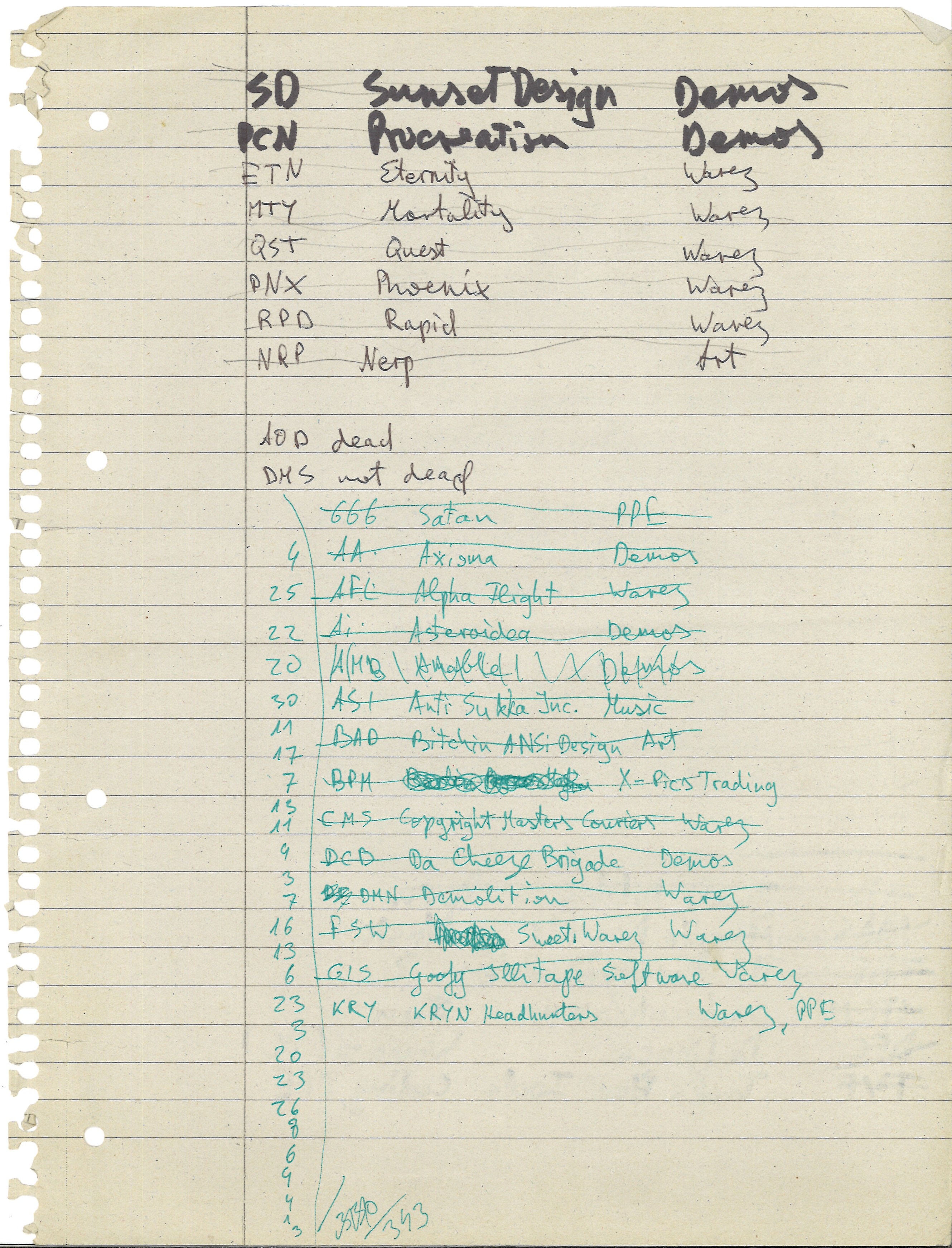
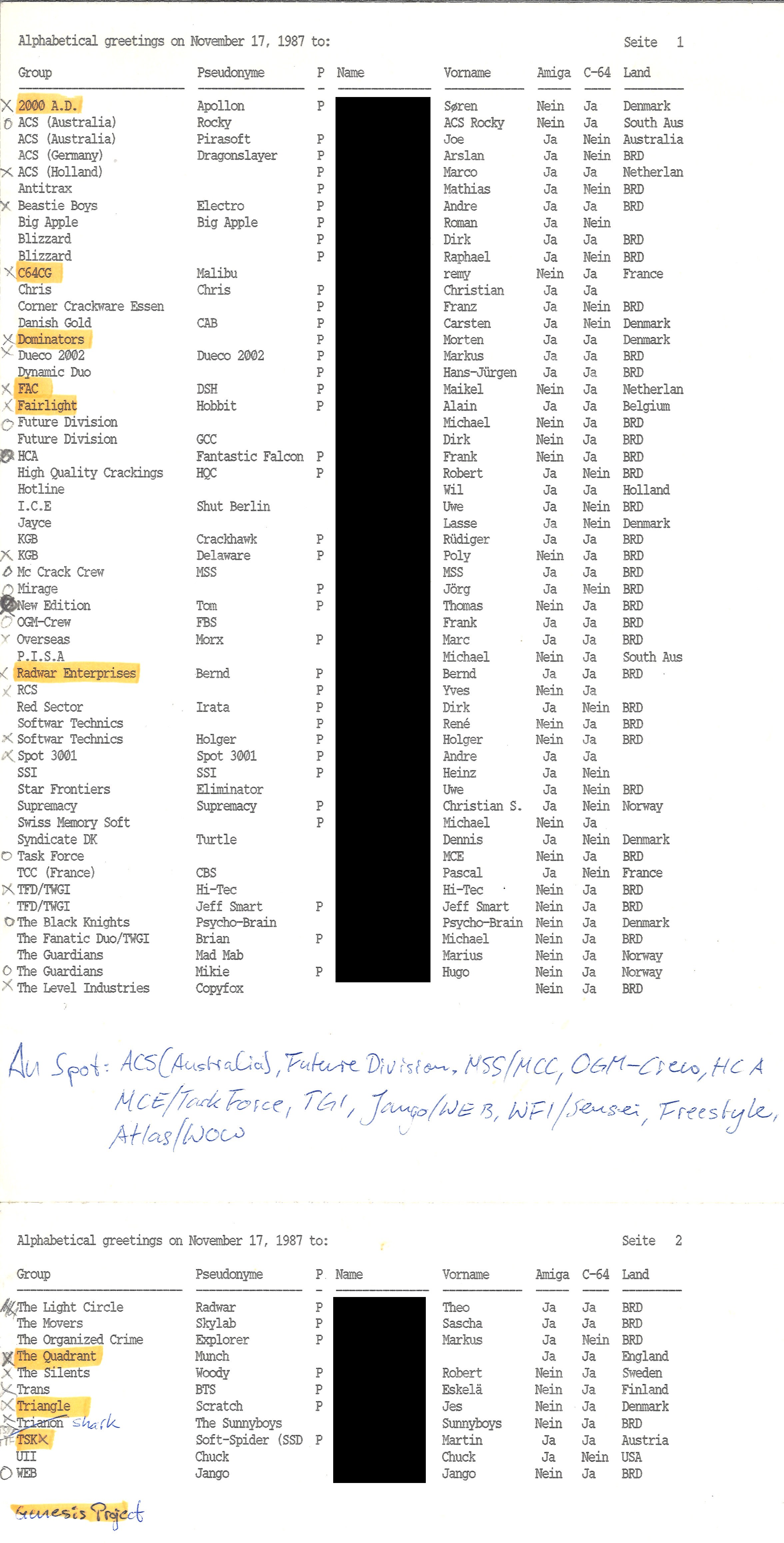
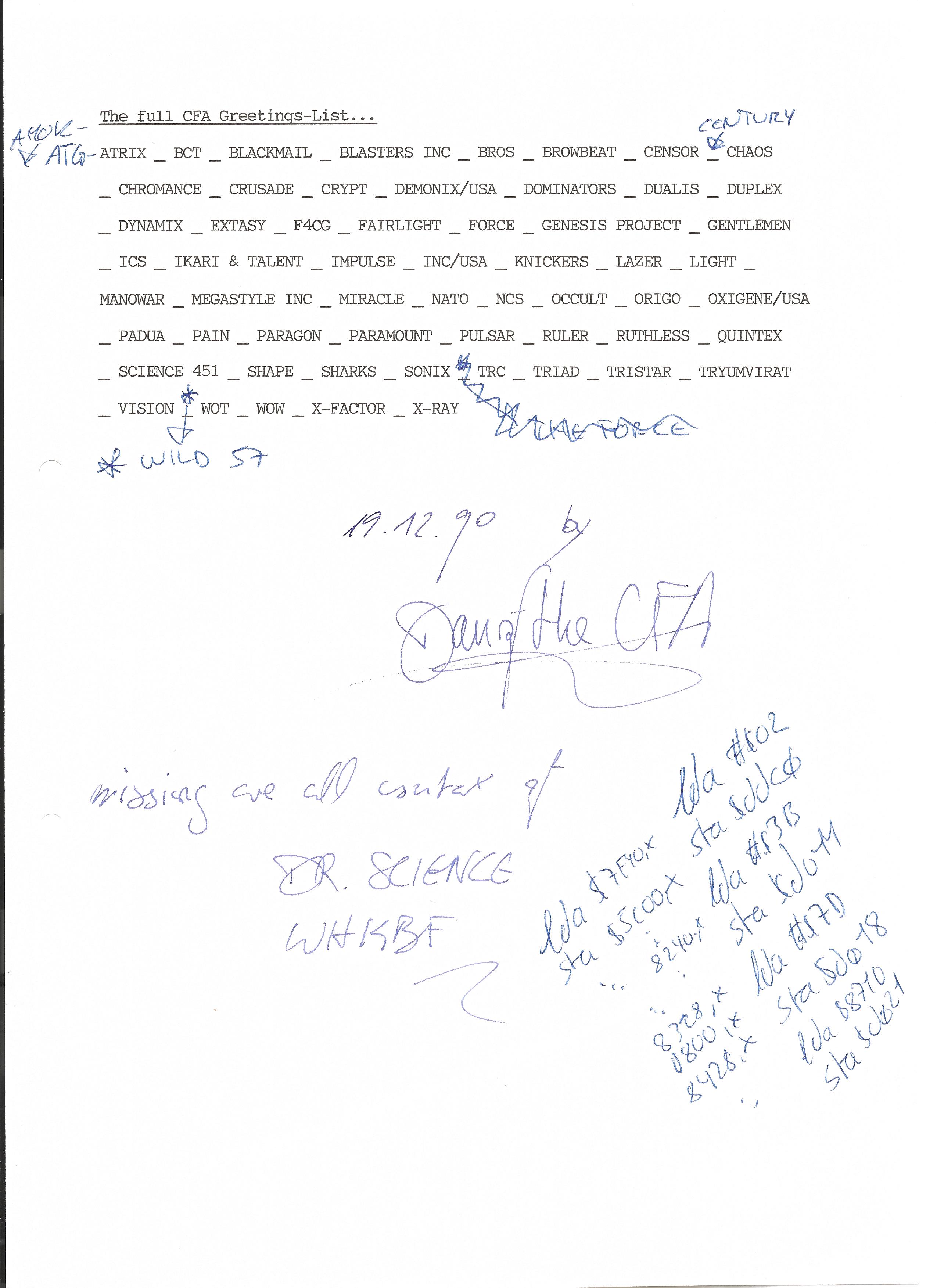
Thank you very much, everyone - had no idea it existed! Man, it feels good to be enlightened.
Info :
KGB Crew was around 1985-1987 one of the predecessor of TRISTAR. Located in Wuppertal HQ and lead by Poli Maltsos. He was at this time 14/15 years old. Crackhawk must be also one or the main coder at KGB Crew and later in TRISTAR.
(Ruediger was his Name, Coolcat as being older than me might know more about that time 1985-1987) both were located in Wuppertal as most of the actual team at this time.
OGM Stands for Orgasmatron Crew[/b]located beside Wuppertal in Remscheid. They brought also Terminator aka Arno Seiler to Tristar. He did already the logo Mid of 1987 but it took some time before OGM and KGB formed to TRISTAR with MCP. Fun Fact, MCP was not real a group, it was simple Terminator ! as they said "we need 3 parts for TRI-STAR.
Franky aka Frank Beerman was the leader of OGM
Franky retired somehow in 1988 due busts as active (Co)Leader. Delaware continued his duty but leaved the Warez Business many years later as he started a Console Shop in Wuppertal.
Nowadays, Franky follows his love for Rockmusic and is active in a band and Delaware still does some kind of console stuff / repairings on a legal base. They became both mature husbands with childrens and a so called normal life at the end.
The Story of Tristar in the Computer Warez/Arts Scene endet on 15-9-2012 in favour for TSA - The Solaris Agency with also is a part with the DevLab TSA since early 2020 and rises a whole Makerspace in Wuppertal whis grows from 60m² to 140m² filled with machines, retro consoles, grill, multimedia, electronic, woodshop etc.
From the Beginning in 1985 with KGB Crew till today its a story, that lasts now 41 years and still located in Wuppertal
KGB Crew was around 1985-1987 one of the predecessor of TRISTAR. Located in Wuppertal HQ and lead by Poli Maltsos. He was at this time 14/15 years old. Crackhawk must be also one or the main coder at KGB Crew and later in TRISTAR.
(Ruediger was his Name, Coolcat as being older than me might know more about that time 1985-1987) both were located in Wuppertal as most of the actual team at this time.
OGM Stands for Orgasmatron Crew[/b]located beside Wuppertal in Remscheid. They brought also Terminator aka Arno Seiler to Tristar. He did already the logo Mid of 1987 but it took some time before OGM and KGB formed to TRISTAR with MCP. Fun Fact, MCP was not real a group, it was simple Terminator ! as they said "we need 3 parts for TRI-STAR.
Franky aka Frank Beerman was the leader of OGM
Franky retired somehow in 1988 due busts as active (Co)Leader. Delaware continued his duty but leaved the Warez Business many years later as he started a Console Shop in Wuppertal.
Nowadays, Franky follows his love for Rockmusic and is active in a band and Delaware still does some kind of console stuff / repairings on a legal base. They became both mature husbands with childrens and a so called normal life at the end.
The Story of Tristar in the Computer Warez/Arts Scene endet on 15-9-2012 in favour for TSA - The Solaris Agency with also is a part with the DevLab TSA since early 2020 and rises a whole Makerspace in Wuppertal whis grows from 60m² to 140m² filled with machines, retro consoles, grill, multimedia, electronic, woodshop etc.
From the Beginning in 1985 with KGB Crew till today its a story, that lasts now 41 years and still located in Wuppertal

_19871117.jpg)
